
“The brief is king!”
My first boss, an exceptional marketing director, drummed this into me relentlessly.
I’m glad he did because it has quite honestly shaped every project I’ve been involved in ever since.
From building my first website in the 1990s (yes, I’m that old!) to working with AI platforms today.
Here’s what I have been thinking about for a while:
Everyone’s obsessing over learning to “prompt” AI, as if it’s some mystical new skill you need to master.
Frankly, it’s time to move on.
You’re not prompting anything.
You’re briefing a collaborator.
And, you know how to do this already.
Think about the last time you briefed a designer, a developer, or your team on a project.
You painted the picture, set the context, explained the outcome you wanted, shared the constraints (and in my case, moved your hands a lot).
You were clear, thorough, and thoughtful because you respected their expertise and wanted great results.
That’s exactly what you do with AI. No magic, no special syntax, no new vocabulary to learn.
Your ability to communicate clearly, to think strategically about outcomes, to explain with great emotional intelligence, etc. these aren’t obsolete skills.
They’re your superpowers in an AI world.
‘The brief is king’ because it shows you’re thinking deeply about what you’re doing. It demonstrates respect for the creative process, whether that’s with a colleague, client or an AI assistant.
Most importantly, it’s an invitation. The brief says: come join me on this project adventure, here’s everything you need to make it brilliant.
So next time you sit down with ChatGPT, Claude, Perplexity or any AI tool, don’t think “I need to learn prompting.”
Think “I’m about to brief the most capable team member I’ve ever worked with.”
Trust me, the difference in your results will be literally extraordinary.
To your success!
Pascal
AIAdoption Leadership DigitalTransformation
🎵 “Just a little bit” 🎵
Those words have been on my mind this week as I watch the growing AI backlash unfold across content marketing.
And for good reason, there seems to be no limits to the flood of AI-generated audio, photo and video filling our social feeds.
By the way, experimentation is absolutely fine (I do my fair share). Targeted and intermetent use of AI-generated media is probably fine too.
But that is not what I am seeing.
I find myself blaming the platforms who seem to favour this type of content, rewarding fake messages over real voices.
So, how do we, the ones who care deeply about ethical practice, avoid being tarred with the same brush?
How do we make sure our current and future customers do not confuse us with the worst examples in our sector?
The answer, I think, is just a little bit.
Just a little bit more storytelling about our ethical practices. Sharing how we actually use AI when we produce our podcasts and our videos, and where we choose not to.
Just a little bit more leading by example. Showing our working and letting people see the human thinking behind the images we share and the audio we publish.
Just a little bit more of taking a clear stand. Making our position known and saying out loud what we believe and what we will not do.
Mitali Deypurkaystha and Dr Yulia Dzenkovska have explored this extensively with the Human-First Responsible AI Pledge.
Suspect use of AI is loud, and again, I blame the platforms for that.
Thoughtful use of AI needs to be visible. Not in a noisy way. Just a little bit more.
To your success!
Pascal
PS: my “Just a little bit” is the Etta James version of course, although the Gina G. is good fun too!
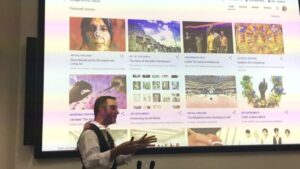
Photo Caption: Pascal Fintoni talking about Google Arts & Culture platform at Leeds Conference

“Is visiting your website like opening a near-empty fridge?”
You know the feeling.
It’s 7pm, you’re looking forward to cooking something, you swing open the fridge door hoping for inspiration.
And there it is: half a jar of something suspicious, wilted vegetables, maybe some leftovers.
Meh. A little empty inside.
We’ve all been there with fridges.
But are we doing the same thing to our websites?
Your current customers visit hoping for fresh ideas, new insights, something that surprises them.
Your future customers arrive looking for a reason to believe you’re the right choice.
And what do they find?
The digital equivalent of that suspicious jar and wilted lettuce.
A homepage that hasn’t changed in months.
A blog with the last post from 2023.
An “About Us” page that could describe any business in your sector.
Here’s what we need:
Ingredients. Sparks of ideas. Content that makes us, and our visitors, think: “Oh, that’s interesting.”
Your website should inspire you first.
If it doesn’t excite you when you look at it, why would it excite anyone else?
Stock the shelves. Add fresh ingredients regularly. Give people something substantial to work with when they visit.
Because a well-stocked fridge means possibilities.
A near-empty one means ordering takeaway and going somewhere else.
Which one is your website?
To your success!
Pascal
And a reminder…
If you feel ready to stock your digital shelves, consider buying your own copy of ‘WebProud: The 5-Step Roadmap to Feeling Proud of Your Website Again!‘ and get in touch to find out our next website masterclass near you.