
In this article

Content Spotlights is the segment in the Two Geeks and a Marketing Podcast where Roger Edwards and I go hunting for content pieces that made us think, react, or reach for the pause button.
In Episode 131, we ended up covering two very different subjects that, on the surface, have little in common:
A pair of beautifully crafted UK food advertisements, and the quiet, steady success of Roger’s own YouTube channel, RogEdwardsTV.
But the more we talked, the more the threads started to weave together. Both stories are fundamentally about the same thing: what it means to create something honest, and why that still matters enormously.
The Key Takeaways

This episode landed at an interesting cultural moment.
Audiences are fatigued by algorithmic content, by interruptive advertising, by the sense that everything they see has been optimised to death. Against that backdrop, the content we spotlighted this week offers something that feels quietly radical: storytelling that respects the viewer.
The practical implications are significant, in particular if you’re a marketer, a brand manager, or a content creator
A Round of Applause for RogEdwardsTV: 12 Years, 14,000 Subscribers, and a Philosophy Worth Stealing
I’ll confess something: I was a little mischievous leaving the show notes blank this week. I wanted Roger to walk into the discussion unprepared, because what I had in mind was a celebration and perhaps a bit of a case study in creative consistency. (I still hope he did not mind!).
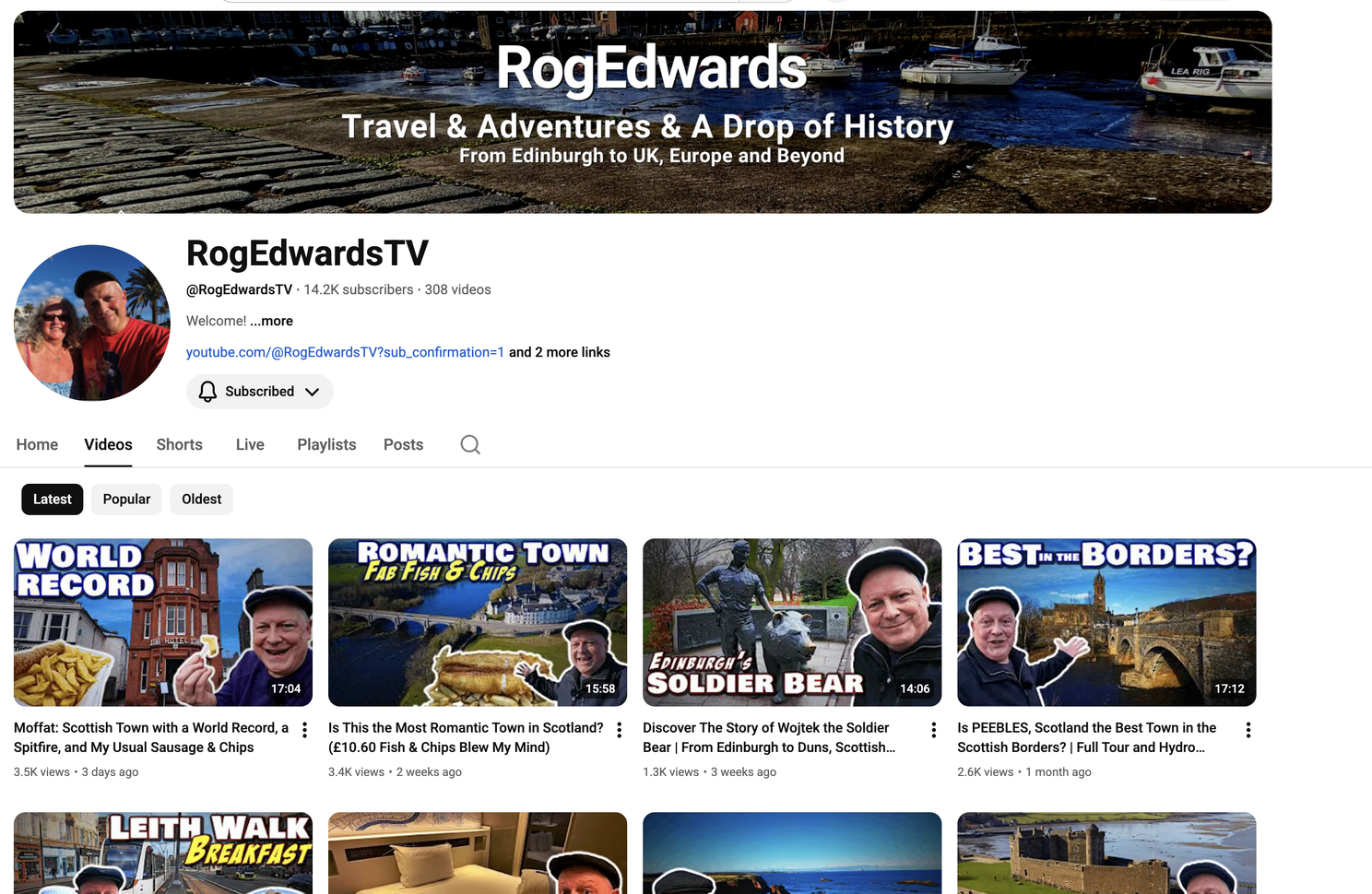
RogEdwardsTV launched on 31 January 2014. As of now, it has accumulated over 14,000 subscribers, more than 300 videos, and upwards of 1.5 million views. Those numbers are not viral-scale. But they’re real, earned, and built entirely without shortcuts.
Every Sunday lunchtime, my wife Denise and I watch the latest episode; it’s become something of a ritual in the Fintoni household. And yes, we do occasionally react and answer back at the screen. Roger cannot hear us, but we feel it’s the right thing to do!
What Roger shared about the channel’s evolution contains some of the most practical content strategy advice you’ll hear.
In the early days, RogEdwardsTV planned to be three things at once: a travel vlog, a marketing tutorial series, and what Roger cheerfully describes as a “ranting channel.” Over time, it became clear that the YouTube algorithm had absolutely no idea what to make of it.
The turning point? Roger deleted around 70 videos (50 marketing tutorials and 15 or so opinion pieces) and committed wholeheartedly to travel and history. Since then, the channel has grown consistently. The lesson is simple: clarity of purpose is not a creative constraint. It’s a gift to your audience.
The channel’s particular charm lies in what Roger calls “a little drop of history”, those historical nuggets that turn a hotel stay or a walk through a city into something worth paying attention to. His series on the former British Transport Hotels is a particular favourite of mine. The Royal Station Hotel in Newcastle, the Balmoral in Edinburgh, the Landmark in London, each one a story hiding in plain sight. Roger films from the perspective of someone arriving somewhere for the first time, genuinely curious, script loosely held, ready to be surprised. It’s a technique that sounds simple. It is not easy.
We also explored his approach to planning, recording, and post-production, along with his exceptional storytelling talent. Which led into a fascinating side discussion on advertising relevance, sparked by a digression about the YouTube ads appearing on Roger’s videos.
I was initially ready to give YouTube a hard time. You see, the ads are often completely unrelated to the travel and history content on screen. Nappies. Makeup. Things that make no sense alongside a video about a Victorian railway hotel. But our colleague Natalie pointed out, quite correctly, that this isn’t YouTube’s failure, it’s the advertisers’. Too many brands hand over their budget and essentially say to the platforms: “do your thing,” without investing even ten minutes in audience profiling. The result: ads seen by the wrong people, on the wrong content, at the wrong moment. It’s not rocket science, but apparently it requires more effort than many are willing to make.
On the subject of advertising…
The Food Vibe Shift: When Waitrose Went to Space and McDonald's Crashed Fashion Week
Roger’s spotlight this week centred on two recent UK food advertisements that, in his words, needed to be showcased. He came across them while investigating the Super Bowl ad landscape, a search that yielded little excitement, and stumbled onto something far more interesting closer to home.
The Waitrose Gastronaut
The first is Waitrose’s campaign called The Gastronaut, and it is, without question, a mini science fiction blockbuster. Think 2001: A Space Odyssey crossed with Passengers, with an Aerosmith soundtrack courtesy of Armageddon.
An astronaut aboard a gleaming space station is sustained entirely by nutrient tubes, squeezing concentrate into his mouth, day after day, surrounded by breathtaking technology but utterly devoid of joy.
Eventually, he reaches his limit. He suits up, takes the shuttlecraft, returns to Earth, goes to Waitrose, and sits outside with his helmet off eating prawn linguini.
It is, in essence, a 90-second argument for the pleasure of real food. And it works because it doesn’t tell you what to eat, it shows you what it feels like to be deprived of something genuinely human, and then reunited with it.
The storytelling is elegant, the production values are extraordinary, and the emotional payoff is earned rather than manufactured.
The McDonald’s All Flavour, No Mess
The second campaign, McDonald’s All Flavour, No Mess, takes a completely different approach. And Roger, who will freely admit he’s no fan of McDonald’s food itself, was full pf praises for the simple yet impactful execution. Fashion models in immaculate white clothes. London Fashion Week energy. Hip hop music. And the central tension: how do you eat a McDonald’s without destroying the outfit?
The answer, it turns out, is their new wrap format, a push-up packaging that keeps the mess contained. The campaign promotes a product feature through cultural aspiration rather than functional explanation. It is very clever, and likely to land particularly well with younger audiences. Roger’s comment, that he found it effective despite genuinely disliking the product, is perhaps the highest compliment an ad can receive.
What connects both campaigns is something I find genuinely encouraging: a return to the idea that advertising should give people something. An emotion, a story, a moment of recognition.
For years, the dominant logic of digital marketing told us to be fast, be blunt, and get to the point within five seconds before the skip button appears. These two campaigns essentially say: non merci. We trust our audience. We’re going to take our time.
Both ads also use music purposefully — not as wallpaper, but as narrative architecture. The Aerosmith track in the Waitrose piece has a lifetime of cinematic associations behind it. The contemporary hip hop in the McDonald’s campaign signals exactly the world the brand is trying to inhabit. Music does something text and visuals alone cannot: it tells you how to feel.
I pointed out during our conversation that both the food campaigns and Roger’s YouTube channel are responses to the same cultural condition: audiences who are fed up with content that treats them like a metric.
The Waitrose astronaut is tired of his concentrate. Roger’s viewers come back every Sunday because they know he’s genuinely discovering something, not performing discovery. McDonald’s fashion models want to eat properly and look good doing it.
It’s not a coincidence, it’s a correction: a shift back toward content that respects the audience enough to mean something.
- Pascal and Roger
🔗 Useful Links:
Watch more video magazines: https://www.youtube.com/channel/UCChv7HnP_ZqGoFQbzqkeaKA?
Listen to the podcast version: https://two-geeks-marketing-podcast.captivate.fm/
Cats, Mats and Marketing Plans: How to build a simple marketing strategy and avoid complexity as your business grows – Book by Roger Edwards
WebProud: The 5-step roadmap to feeling proud of your website again – Book by Pascal Fintoni and Jonny Ross
Connect with Pascal Fintoni: https://pascalfintoni.com/ https://www.youtube.com/@PascalFintoni_on_YouTube
Connect with Roger Edwards: https://rogeredwards.co.uk/services/ https://www.youtube.com/@RogEdwardsTV
BONUS: the 'so what' or 'now what' extended article:
In collaboration with my digital assistant, AI-LEEN, I’ve compiled this long-form article revisiting the Content Spotlights segment of our show, with a particular focus on what you, as a business leader and senior marketer, might need to consider and act on.
🤔 Three Essential Questions for Your Business
Three Questions You Should Be Asking Yourself
1. Does my content have a clear identity… or is it trying to be too many things at once?
Roger’s channel only started to flourish when he made a clear editorial decision about what it was for. Look at your own content output: your blog, your social channels, your newsletter. Is there a coherent throughline, or are you hedging? The algorithm doesn’t reward hedging. More importantly, neither does your audience.
2. Am I giving my audience something to feel… or just something to know?
The Waitrose and McDonald’s campaigns work because they lead with emotion and use product features as supporting evidence. Audit your last five pieces of content. Did they make someone smile, think, or feel something? Or did they primarily deliver information? Both have their place, but in a saturated environment, feeling tends to travel further.
3. Am I making content decisions based on what I would want to receive… or what I think the algorithm will reward?
Roger’s refusal to chase algorithmic trends reflects a deep commitment to audience-first thinking. Rather than bending to YouTube’s formula, he focuses on crafting a rich visual and aural experience for his community, ultimately guided by what resonates with people, not what performs for platforms.
📋 Three Actions to Transform Your Business Narrative
1. Do a content clarity audit
List all the content channels and formats you currently maintain. For each one, write one sentence describing what it’s for and who it’s for. If you can’t write that sentence easily, you have a clarity problem. Be willing to do what Roger did: edit ruthlessly, even if it means deleting things you worked hard to create. Clarity will serve you better than volume.
2. Study great advertising with professional eyes
Watch both the Waitrose Gastronaut and the McDonald’s All Flavour, No Mess campaign (links below) not as a consumer, but as a marketer. Note the structure, the music choices, the emotional arc, the moment the product appears. Ask yourself: what could I borrow from this approach for my own content? Not the budget — the thinking.
Waitrose Gastronaut https://www.youtube.com/watch?v=y1d9tvV4SZw
McDonald’s All Flavour, No Mess https://www.youtube.com/watch?v=MflZUv-4c3Y
3. Invest ten minutes in audience profiling before your next paid promotion
Whether you’re running YouTube pre-rolls, social ads, or sponsored content, spend time defining your audience beyond the basics. Geography, interests, content context. That ten-minute investment is the difference between a nappy ad appearing on a railway hotel video and a relevant travel brand reaching exactly the right viewer at exactly the right moment.
⚠️ Three Pitfalls to Avoid
1. Confusing activity with strategy
Posting consistently is not the same as creating purposefully. Many brands and creators are incredibly busy producing content that serves no clear editorial or business objective. Before you create another piece, ask: why does this exist? If the honest answer is “because we haven’t posted this week,” that’s a sign to pause and recalibrate.
2. Accepting irrelevance in exchange for income
Roger’s principle here is one worth adopting: if the association makes no sense, the income isn’t worth the trust you’ll lose. This applies to brand partnerships, sponsored content, guest contributors, and yes, the ads you choose to serve on your own platforms. Relevance isn’t just a nice-to-have, it’s the foundation of credibility.
3. Underestimating the power of slow growth
Twelve years. 14,000 subscribers. More than 300 videos. None of those numbers happened overnight, and none of them were achieved by chasing trends. Roger has built something that generates genuine community by showing up consistently and caring about quality. In a landscape obsessed with virality, this kind of patient, purposeful growth is quietly radical. Don’t let the absence of explosive numbers fool you into thinking something isn’t working.

Final Words: On the Quiet Power of Caring About Your Craft
What struck me most about this episode, with Roger’s story alongside those two beautifully made food campaigns, is how much they all have in common beneath the surface. They’re all, in their different ways, expressions of someone caring deeply about the experience they’re creating for other people.
The Waitrose creative team cared enough to build a miniature sci-fi epic instead of a product demo. McDonald’s cared enough to embed a functional benefit inside a cultural moment rather than just explaining it. Roger has cared enough, for twelve years, to show up every week with genuine curiosity and no protein shake sponsorships.
As a content marketing strategist, I spend a lot of time helping organisations find that same quality of care, the clarity of purpose, the emotional intelligence, the editorial discipline that turns content from noise into something worth paying attention to. It’s not a formula. It’s a commitment.
And in a media landscape that often rewards speed over substance and volume over value, committing to that kind of quality is, I believe, both the hardest thing and the most important thing you can do.
Pascal Fintoni is a specialist AI content marketing skills and strategy consultant who helps businesses transform their communication through the power of strategic storytelling.